Changing How the World Communicates with People Who Are Hard of Hearing
Advancing global hearing access across transportation, technology, museums, telecommunications, and culture.
Janice S. Lintz is a social policy entrepreneur who has spent more than two decades advancing communication access for people who are deaf or hard of hearing across transportation, technology, museums, telecommunications, and culture.
Equipped with an undergraduate business degree, a law degree, and a Master of Public Administration from Harvard Kennedy School.
Lintz is known for translating accessibility challenges into practical business and policy solutions that organizations can implement.
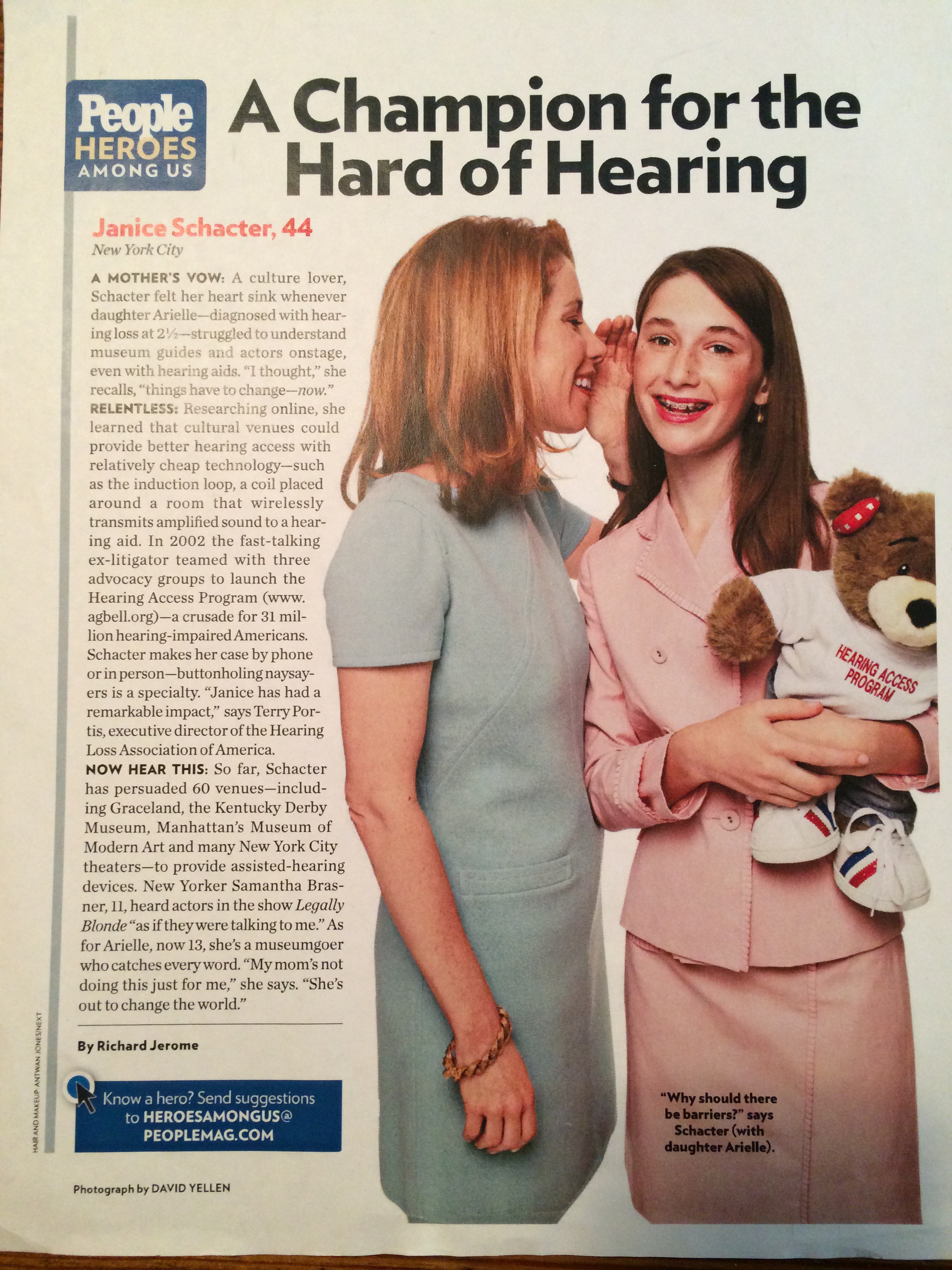
Her work began when her daughter, diagnosed with hearing loss at age two and a half, struggled to understand museum guides and theater performances even while wearing hearing aids. Determined to improve access since it was easier to change the world than lower her standards, Lintz researched existing technologies. She discovered that cultural venues could significantly improve hearing access using relatively simple solutions such as induction loop systems, which transmit sound directly to hearing aids and cochlear implants.
Working pro bono with organizations worldwide, Lintz has helped develop standards, policies, and innovations that have expanded hearing access for millions of people.
Impact Highlights
Since 2002, Lintz has helped catalyze accessibility improvements across transportation, technology, museums, telecommunications, media, and consumer culture.
Transportation & Public Infrastructure
• Led efforts that resulted in induction loops being recommended for New York City subway information booths and call boxes as part of President Obama’s $13.5 million stimulus package.
• Worked with the NYC Taxi and Limousine Commission to install induction loop technology in taxis, making New York City the first city in the United States to offer hearing loop technology across multiple transit systems.
• Initiated advocacy for hearing access in aviation, partnering with Richard Branson of Virgin Group to add captions to in-flight entertainment systems; Delta, United Airlines, and other airlines later followed.
• Introduced the concept of induction loops at airline gates to Delta leadership, leading to adoption by Delta and other major airlines.
• Promoted the use of induction loops in rail systems, leading to installations in San Francisco’s BART system.
• Advocated for and secured the inclusion of induction loop technology in Amtrak’s 2025 rail cars, making them the first passenger trains in the United States to provide hearing loop access in every car.
Healthcare, Technology & Telecommunications
• Catalyzed the development of Over-the-Counter hearing aids through advocacy with Senator Elizabeth Warren and engagement with Apple’s entry into the hearing aid market. The Food & Drug Administration cited her testimony in the Proposed rule for Medical Devices; Ear, Nose, and Throat Devices; Establishing Over-the-Counter Hearing Aids‘s footnotes.
• Identified regulatory gaps between the FCC and FDA related to hearing aid compatibility and RF interference, leading to voluntary compliance measures that enabled hearing aids and mobile phones to work together reliably.
• Authored the widely downloaded article, “How to Buy a Cell Phone if You Have a Hearing Loss,”which exposed regulatory gaps and helped push mobile carriers to provide accessible compatibility information. Today all major carriers and iPhones are hearing-aid compatible.
• Advocated with the FCC through testimony, meetings, and regulatory comments (2016, 2020, 2023, 2024) to preserve telecoil functionality in smartphones despite industry pressure to eliminate the feature.
Museums, Culture & Public Institutions
• Spearheaded induction loop installations across Smithsonian museums through sustained engagement with the Congressional Appropriations Committee, resulting in multiple appropriations directives. (See 2021, 2022, 2023, 2024 and 2026: p91)
• Testified before the U.S. Congressional Subcommittee on the National Park Service, helping reinstate Recreation Fee Program funding that improved hearing access in national parks.
• Co-authored the National Park Service Accessibility Guidelines for hearing loss, establishing a federal definition of “effective access.” (Acknowledged on page 76.)
• Collaborated with Joseph Brodecki, founder of the United States Holocaust Memorial Museum, to implement induction loops and captions throughout exhibits.
• Partnered with the U.S. Pentagon/Air Force to incorporate hearing access at the Dayton Aviation Center and later the Intrepid Museum, enabling them to host the U.S. Space Shuttle.
Built Environment & Accessibility Standards
• Transformed Yankee Stadium into the most hearing-accessible stadium in the United States.
• Co-authored an International Code Council (ICC) standard requiring induction loops at service windows in stadiums worldwide.
• Catalyzed the installation of induction loops in Broadway theaters, prompting the Nederlander Organization to include loop systems during renovations.
Media, Standards & Public Communication
• Collaborated with the Association of National Advertisers to establish closed caption standards for television commercials, influencing Federal Communications Commission’s (FCC) captioning standards.
• Convinced the Associated Press to update the AP Stylebook to follow the National Center on Disability and Journalism language guidance, removing outdated terms and promoting respectful language about disability.
• Worked with Playbill, The New York Times, and The Wall Street Journal to introduce the ear symbol identifying hearing access in theater directories, helping drive the installation of induction loops in Broadway theaters.
Consumer Culture & Representation
• Persuaded Build-A-Bear Workshop to introduce hearing aid accessories for its teddy bears; the bear is now part of the collection at The Strong National Museum of Play
• This initiative helped inspire broader disability representation in toys across major brands.
Global Accessibility Leadership
• Developed a three-pronged hearing effective communication framework in 2002 to improve access for people who are deaf and hard of hearing. The model has been adopted by more than 100 locations worldwide.
• The framework was later endorsed by the American Alliance of Museums and the National Park Service and informed accessibility work with the Royal Collection (UK), the Stavros Niarchos Foundation (Greece), the government of Ecuador (English and Spanish,) and Nestlé’s Maison Cailler (Switzerland).
• Helped establish New York City as a model for hearing access, integrating induction loops across museums, Broadway theaters, subway information booths, and taxis. These initiatives were later studied by the National Park Service and the U.S. Access Board and reported in The New York Times.
Philanthropy & Systems Change
• Persuaded Darren Walker at the Ford Foundation to launch the foundation’s first grantmaking initiative dedicated to disability rights in the United States, resulting in an annual budget of $10 million and more than $50 million invested in disability organizations between 2018 and 2020.
Awards
Lintz has received numerous recognitions for her work. She was named a 2025 World Health Organization World Hearing Forum Changemaker, a 2023 Presidential Management Fellow Finalist, and a 2023 Forbes 50/50 Finalist. In 2022 she received Congressional Recognition from Representative Paul Tonko and was inducted into the NYS Disability Rights Hall of Fame.
Her work is featured in The Strong National Museum of Play’s exhibit on Build-A-Bear hearing aid teddy bears. She has been profiled in The Success Factor and cited in the FDA’s proposed Over-the-Counter Hearing Aid regulations. Her work has also been featured in the books Tell Her She Can’t: Changemaker and Beyond Diversity.
Additional recognitions include the 2018 Points Guy and Gates Foundation Goalkeepers Travel Grant, the 2016 Aspen Institute Spotlight Health Scholarship, the 2016 United State of Women Summit Changemaker nomination, and being named a People Magazine Hero in 2008.
Advisory Roles
Lintz has held numerous advisory roles. She was appointed twice by New York State Governor David Paterson to the Interagency Council for Services to the Deaf, Deaf-Blind, and Hard of Hearing. Federal Communications Commission Chairman Kevin J. Martin appointed her to two terms on the FCC’s Consumer Advisory Committee representing the interests of people with hearing loss. The New York City Mayor’s Office appointed her to the Taxi of Tomorrow Stakeholder Committee. The U.S. Access Board appointed her to both the Rail Committee and the Passenger Vessel Emergency Alarms Advisory Committee.
She has also served on advisory boards including the Burton Blatt Institute at Syracuse University and the Lower East Side Tenement Museum.
Travel
Janice is also a former consumer travel writer. Her work has appeared in Thrive Global, The Outdoor Journal, Forbes Lifestyle, Forbes Woman Africa, Yahoo Travel, Huffington Post, Johnny Jet, and Consumer Mojo.
The BBC, Condé Nast Traveler, Daily Mail, Departures, Forbes, Fox Business, Good Housekeeping, MarketWatch, MSN, NPR, Peter Greenberg, Reader’s Digest, Skift, Southern Living, The Washington Post, Travel + Leisure, USA Today, and the Wall Street Journal have quoted her travel expertise.
She has traveled to 185+3 UN countries and 275 Travelers’ Century Club destinations in her quest to visit every country in the world.